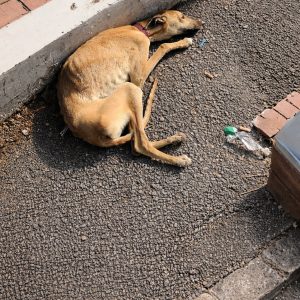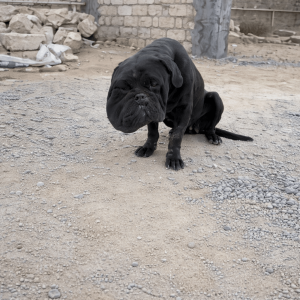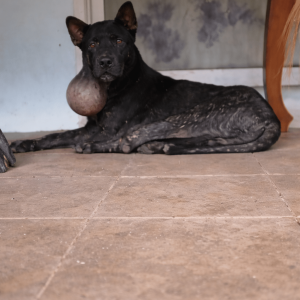
Imagine this for a moment: food sits right in front of you, but your mouth won’t open. Water is within reach, yet you can’t drink. The sun beats down. Your throat burns. And no matter how hard you try—there’s no escape.
Now stretch that nightmare across ten days.
For one stray dog in a quiet rural village roughly 160 kilometers from Hyderabad, this wasn’t a thought experiment. It was reality—harsh, relentless, and almost impossible to survive.
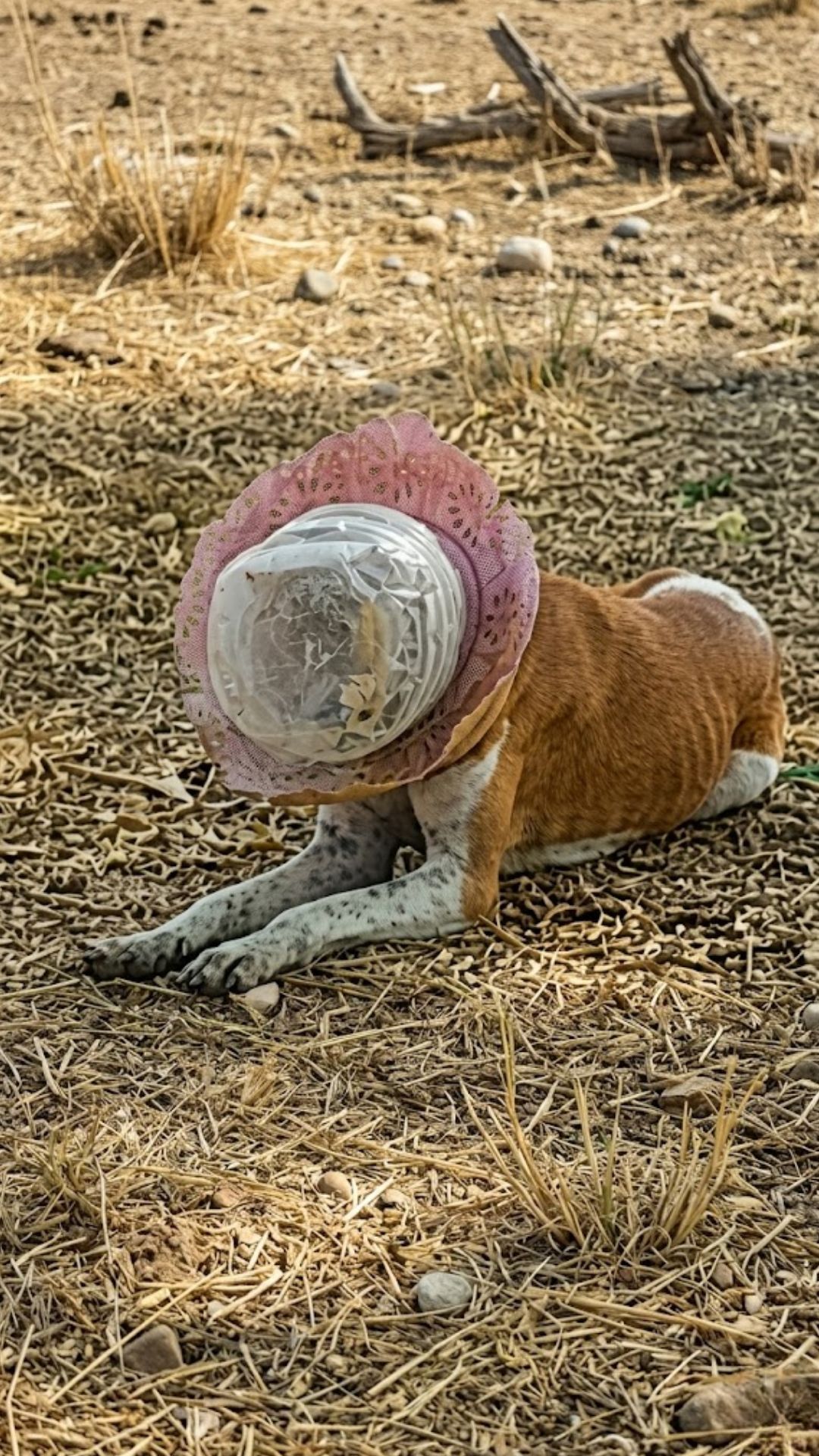
When villagers first spotted her, they froze in shock. She barely resembled a dog anymore. A rigid plastic container had sealed itself around her head, completely covering her face. From afar, she looked ghostlike—wandering silently through fields, trapped inside what seemed like a suffocating mask.
VIDEO: 10 Days Without Food or Water — Watch the Exact Moment She’s Freed From the Double Plastic Trap
A Cruel Twist of Fate: Trapped Not Once, But Twice
Her ordeal didn’t start that way—it escalated.
Weeks earlier, while scavenging for scraps like many strays must do, she pushed her head into a discarded plastic pot. It got stuck. Sadly, this kind of accident is far too common in places where waste piles up unmanaged.
Locals noticed and stepped in. They managed to restrain her and break the container loose.
They thought they had saved her.
But a thick, jagged ring from that broken pot remained locked tightly around her neck, like a stiff collar she couldn’t remove.
Still hungry days later, she searched again. And in a cruel twist, she pushed her head into another plastic container. This time, that leftover ring from the first trap acted like a wedge—locking the second container firmly in place.
Now she was completely sealed in.
No food.
No water.
No way out.
Every time someone tried to approach, she ran. Fear made her quick. Attempts to help only pushed her farther away, deeper into bushes and fields. Day by day, she weakened—but instinct kept her moving.
A Race Against Time
Eventually, the villagers realized they couldn’t do it alone. They reached out online, hoping someone—anyone—could help.
That call reached the Animal Warriors Conservation Society, a rescue team known for tackling extreme cases.
The message was simple—and urgent:
She has been like this for ten days. She won’t survive much longer.
Without delay, the team set out, traveling 160 kilometers into the countryside. By the time they arrived, night had already fallen.
Waiting wasn’t an option.
Ten days without water is often fatal.
With flashlights cutting through the darkness, they searched fields and thorny brush, calling softly, listening for even the slightest movement.
But she was clever. And terrified.
She stayed hidden.
One Chance. No Mistakes.
At first light, they finally found her.
She was curled deep inside a dense patch of bushes. The plastic container caught the early sunlight. Her body was thin now—ribs visible, movements slow. She was conserving what little strength remained.
The rescuers understood the stakes instantly:
They would only get one shot.
If she broke free again, adrenaline might carry her too far to be found in time.
Silently, they positioned themselves around the bushes. No shouting. No sudden moves. Just quiet signals and careful steps.
Then—everything happened at once.
The net dropped.
She was secured before she could run.
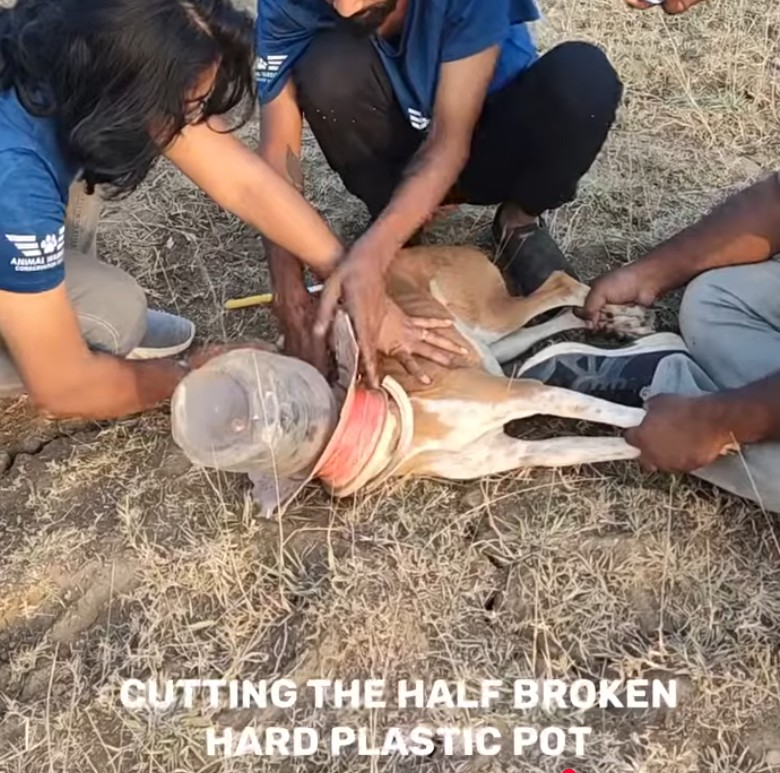
Holding her gently but firmly, the team worked fast. Industrial cutters pressed against the hardened plastic.
Snap.
The outer container cracked open.
Snap.
The jagged collar from the first trap finally broke free.
And then—
For the first time in ten days, nothing stood between her and the air.
No plastic.
No barrier.
Just breath.
She didn’t growl.
She didn’t fight.
She simply shook her head, as if trying to process what freedom felt like… and ran.
But this time, she wasn’t running away.
She was running back to life.
More Than a Rescue
This isn’t just a survival story.
It’s about people who refused to look away.
It’s about rescuers who drove through the night because every hour mattered.
It’s about persistence—on both sides.
160 kilometers traveled.
10 days without food or water endured.
2 plastic traps finally removed.
Plastic waste isn’t just an eyesore scattered across the land. For animals, it can become a silent weapon—slow, suffocating, and deadly.
Because someone chose to act, this story didn’t end in loss.
It ended in freedom.